
Q&A – Ask Neil: September 17, 2026
(Please read these instructions carefully.)
Before you post your question, please look at recent issues to see if someone else has already asked it. You might find your answer there.
HOW TO SUBMIT YOUR QUESTION…
• Click here to post your question. (Please post your question only one time.)
• Please use this link only for posting questions – not for standard e-mails.
• High-resolution photos (1-2MB – not thumbnails) attached with your question help Neil give you the best possible answer. Please check your photo for clarity and exposure. If you do not see “All images clickable for larger views,” your images’ resolution was not sufficient for enlargement. That might also have made it difficult for Neil to give you an accurate answer.
• Neil chooses questions of greatest reader interest. Plant IDs rarely fit that description.
• Neil requires your first name or initials, also your city or county for an accurate answer. (Texas is a very large state.)
• One question per reader per week, please.
• Watch for Neil’s reply in the next issue of e-gardens.
Note: If you have submitted your question and did not see the pop-up window for attaching your photo, please click here.
QUESTION 1
WHY ARE THERE RANDOM DEAD AREAS IN MY PECAN TREE’S BRANCHES?
Question: My pecan tree has random dead branches. In taking the photos I noticed another tree has the same. And, there are others in the neighborhood. What is going on? Jana M., Chandler.
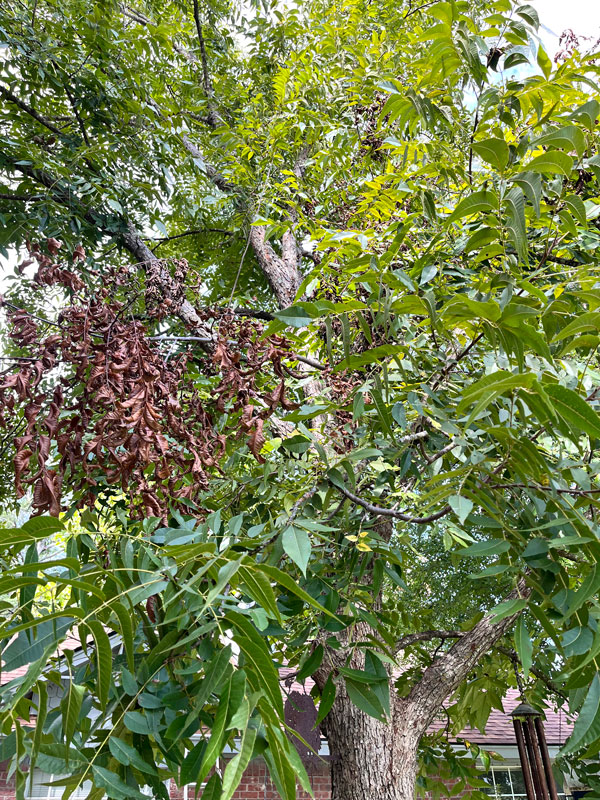
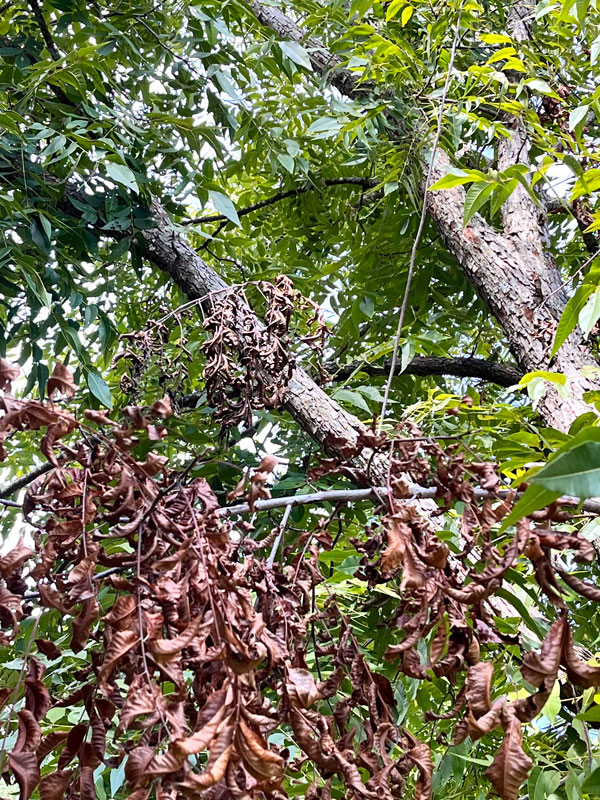
Image clickable for larger views.
Answer: I can’t see the actual damage on any of your photos, but this is almost always due to squirrels gnawing the bark off the limbs as they sharpen their teeth. Their teeth are constantly growing, and it’s common for them to peel bark off pecans, live oaks, and several other species. In the process, the branches die from those points outward. Eventually the dead branches up to 1-in. in diameter, will break and fall to the ground. It doesn’t do any major damage to the trees and there isn’t anything you can do legally to stop the squirrels. It’s primarily disfiguring. I have it in my own pecan trees, too.
QUESTION 2
HOW SHOULD I PRUNE MY LAVENDER PLANT?
Question: Please advise on pruning this large lavender plant. It has done well for several years, but now it looks like it needs to be trimmed. I am unsure how much should be removed. Karen D., Midland.
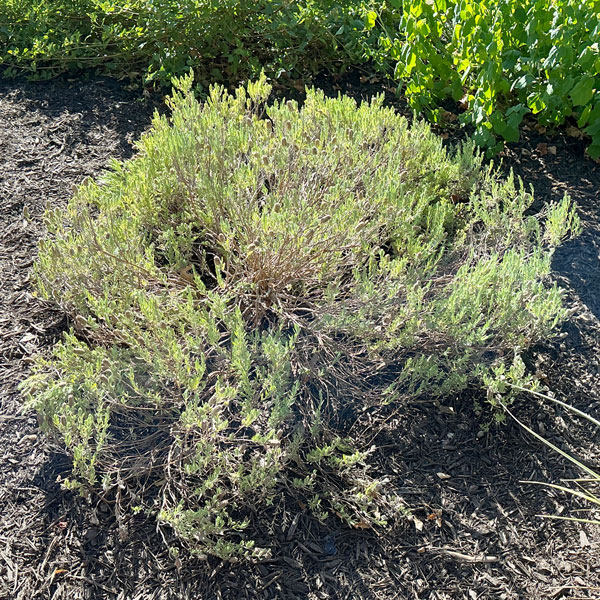
Answer: Trim away about one-third of the top growth using a really sharp pair of bypass pruning shears. Tailor the plant to remove all weak stubble. Water it deeply and apply a diluted solution of a water-soluble, high-nitrogen plant food. You can do that now to promote a bit of new growth before winter and to get the plant ready for spring.
Lavender plants would really be happier if Texas were about 20 degrees cooler. (Wouldn’t we all!) They really struggle with our heat and low humidity. You’ve done well to keep it going for several years against all odds.
QUESTION 3
HOW DO I TIME APPLICATION OF FALL PRE-EMERGENT?
Question: Do I wait until daytime temperatures are around 75F or when night soil temperatures are in the 60sF to apply my fall pre-emergent? Also, if temperatures drop and I make my application, then we get another burst of hot weather, will that ruin my application? Dustin H., Sweetwater.
Answer: I think I can simplify it for you. Make your application in Sweetwater by September 10 each fall and you’ll be fine and on time.
Your goal is to have the Dimension or Pendimethalin granules on the ground before the first 60F night with rain or irrigation. For you, that would be before the first strong cold front of the fall. The first fall football game where you’d want to wear a jacket or sweater. Don’t make it too complicated. You want to have the granules down before the winter weeds start to sprout, and they won’t sprout as hot as it’s been this past couple of weeks. If it turns hot again right after you apply them, no big deal. The granules impact the weed seeds as they try to sprout, and they won’t try to sprout until temperatures drop.
QUESTION 4
WHY ARE MY DWARF AMERICAN BEAUTYBERRIES’ FRUIT PALE PINK?
Question: I have two dwarf American beautyberries. However, their berries are always a very pale pink and not the rich beautiful purple I see in all the photos. Are they missing a particular nutrient? Is there anything else I can do to get them to be the normal color? Dennis R., Fort Worth.
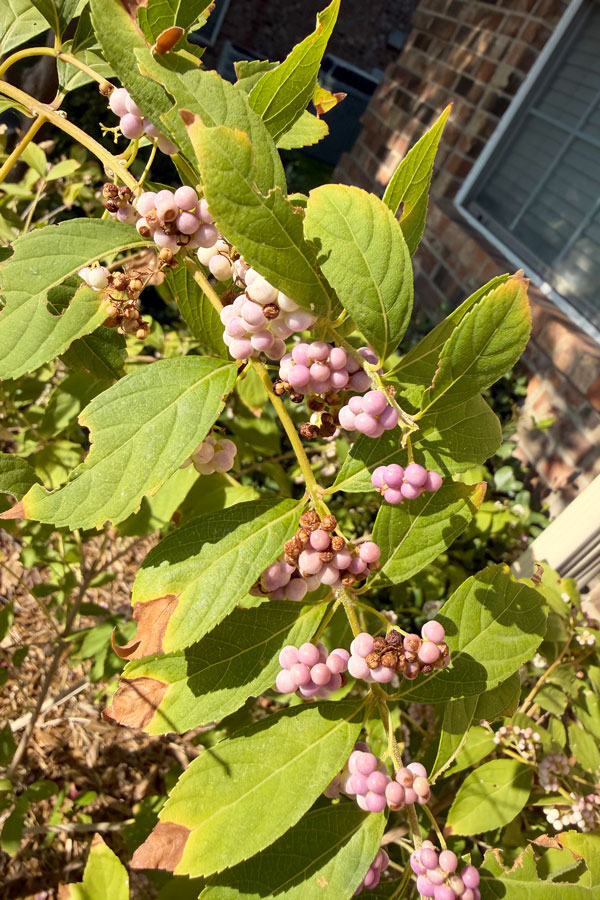
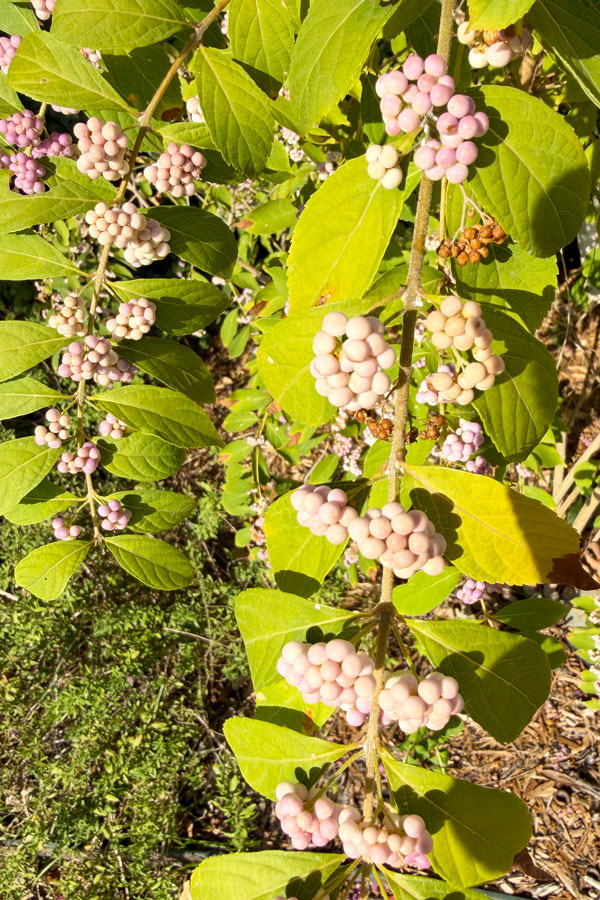
Images clickable for larger views.
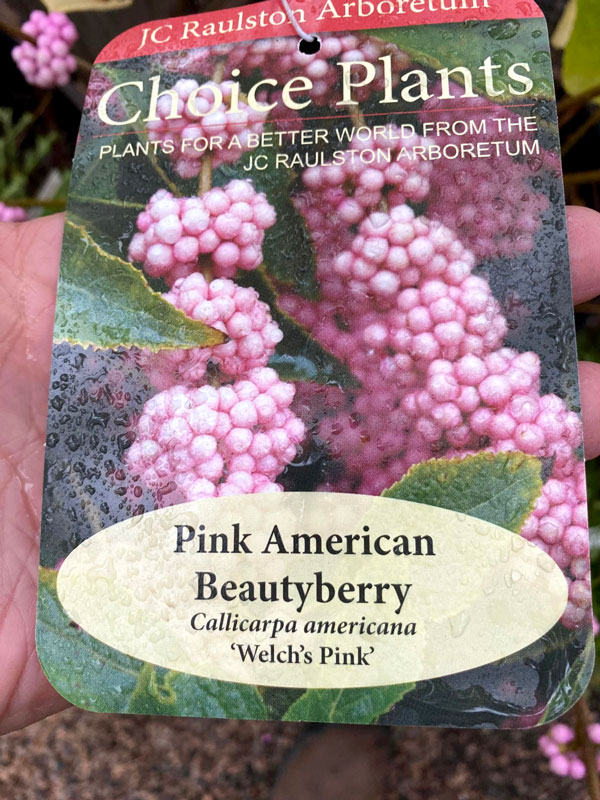
Answer: We have two directions we can turn here. One would be to wonder if your plants might have been exposed to too much sun and heat. But, since you have two plants, and since both are reacting similarly – and since all the berries seem to be turning the same shade of pink, I’m going to move on to Option 2. Before I leave this entirely, however, I will say that it does appear that both plants might benefit from more afternoon shade. This is not caused by a nutrient deficiency.
There is one pale pink cultivar in the nursery trade. It’s named for the horticulturist who found it growing in the Davy Crockett National Forest, Matt Welch, working on behalf of the Stephen F. Austin Arboretum and Dr. David Creech. It’s called Welch’s Pink American beautyberry, and it’s described as being somewhat more compact than the regular species. My bet is that this is the one you have. It’s a wonderful novelty, although maybe not the novelty you were wanting. Here is the writeup on it from the SFA gardens website. Compare their photos to yours.
Note regarding your submissions of questions…
There are fewer questions than normal this week because several of you said you were attaching photos, but then you apparently forgot to do so. I just couldn’t help you without them. I’m sorry. Please follow the directions above and try again this week. Thanks!