
Q&A – Ask Neil: November 5, 2026
(Please read these instructions carefully.)
Before you post your question, please look at recent issues to see if someone else has already asked it. You might find your answer there.
HOW TO SUBMIT YOUR QUESTION…
• Click here to post your question. (Please post your question only one time.)
• Please use this link only for posting questions – not for standard e-mails.
• High-resolution photos (1-2MB – not thumbnails) attached with your question help Neil give you the best possible answer. Please check your photo for clarity and exposure. If you do not see “All images clickable for larger views,” your images’ resolution was not sufficient for enlargement. That might also have made it difficult for Neil to give you an accurate answer.
• Neil chooses questions of greatest reader interest. Plant IDs rarely fit that description.
• Neil requires your first name or initials, also your city or county for an accurate answer. (Texas is a very large state.)
• One question per reader per week, please.
• Watch for Neil’s reply in the next issue of e-gardens.
Note: If you have submitted your question and did not see the pop-up window for attaching your photo, please click here.
Before I begin with this week’s questions, please let me add to my answer regarding Pat T.’s question from Bexar County in last week’s e-gardens. It involved a lawn where the bermudagrass portion had almost totally died while the St. Augustine remained unaffected. It was Q2 in last week’s edition. Here is a link back to that page.
Beth McMann of the Gillespie County Extension office contacted me last Friday to offer another very likely suggestion. She felt this might be pasture mealybugs doing the damage. I am very grateful for her suggestion.
This is a relatively new pest to the United States, and it has done a great deal of damage to South Texas pastures and hay in its couple of years here. Beth said the mealybugs are small and may be difficult to see because they drop off the bermuda and into the thatch. She recommended looking carefully and identifying them with a magnifying glass.
Here is the publication from Texas A&M Extension entomologists. It centers around the pest in hay fields and pastures, but it’s worth reading until more information regarding home lawns comes along.
This pest is a very recent invader, and it is of great concern to several aspects of the agricultural community. For that reason, the United States Department of Agriculture and its entomologists are working closely with state agencies across the South. This website has been recently updated with important information.
To my readers…this will be the final time I’ll cover this topic below. Please read carefully:
QUESTION 1
TELL ME THE DATE FOR FALL PRE-EMERGENT, PLEASE.
Question: I’ve been watching to see when we should apply pre-emergent granules for winter/early spring weeds. Did I miss your recommendation? When and what should I apply in the spring? Candy L., Flower Mound.
Answer: It was Question 1 in last week’s e-gardens. You must have been posting your question as it was distributing. Yes, you’re too late. Dates to apply Dimension or Prodiamine in North Texas where you are would be March 15 and June 15 for warm-season weeds and mid-September for winter and early spring weeds.
QUESTION 2
WHAT IS EATING MY BOUGAINVILLEA LEAVES?
Question: Something is eating the leaves off the tips of my bougainvillea. I have found no insects. I just sprinkled Sevin dust on them. Should I be using something else? Jack K., Brazos County.
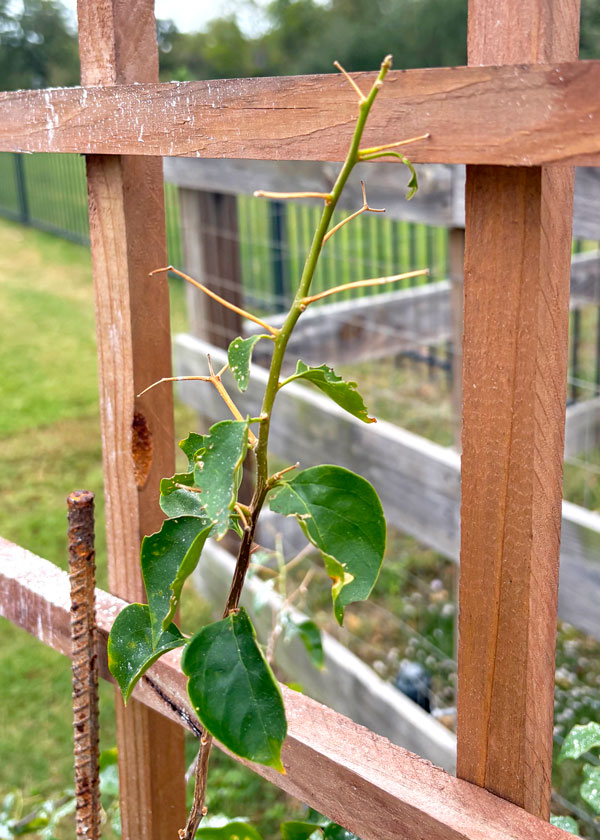
Answer: Something ate (past tense) the leaves off your bougainvillea. Judging from the dried cuts, it looks like this probably happened some months ago.
By far the most common cause I have seen is leaf cutter bees. In fact, I can’t think of any other insect that I’ve ever come across on bougainvilleas.
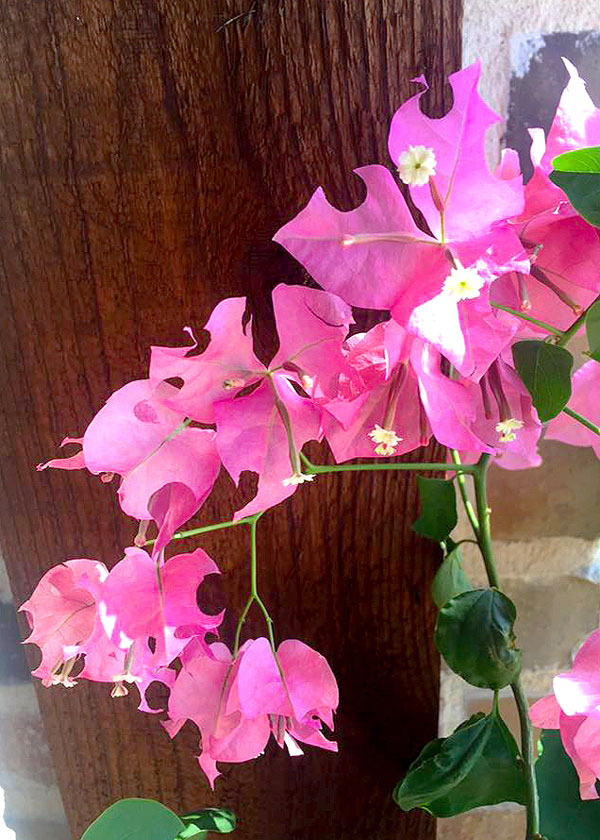
I have attached a photo a reader sent to me several years ago showing the amazing damage done by a leaf cutter bee to his bougainvillea. I get several such questions each summer.
As you can see, leaf cutter bees cut perfect partial circles with their mouthparts. They take the pieces of the leaves to an unused faucet or downspout where they build their nests. You’ll rarely see the adult bees cutting the leaves, but when you turn the faucet on it’s not uncommon to have the dried leaves blow out all over your shoes.
The females really don’t do any major damage to the bougainvillea (other than cosmetic), and unless you’re spraying while she’s there, insecticides won’t help much. Your best bet is to hope for better luck next year. They certainly can be worse one year than the next.
QUESTION 3
IS THIS A GOOD WAY TO WATER MY NEW HOLLIES?
Question: I planted a 3 gal. Nellie R. Stevens holly on October 5. I am very concerned about providing adequate water for the next two years. My soil is red clay, sandstone. I dug holes on each side of the plant. Each hole holds 1-2 gallons of water. My plan is to fill the holes weekly in winter. Is this a good plan? M A C, Tarrant County.
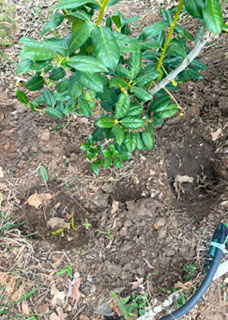
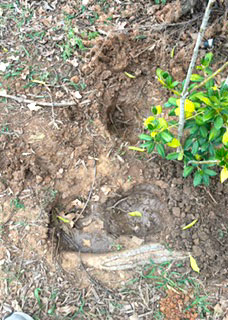
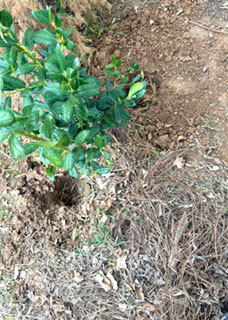
Answer: It would not be my choice, but good for you for thinking of it.
You run the risk of missing half or more of the roots between the holes. Plus, the holes will probably fill in long before the two years runs out.
I very much prefer to use the soil I pull out of the ground as I dig to plant as I create a donut-like berm around each new plant. That allows me to fill the “reservoir” every 2-3 days during the hot weather and every 5 days when it’s cooler. You can then use a hoe to remove the berm once the plant is established and able to make it on its own.
QUESTION 4
WHAT WOULD HAVE CAUSED MY HOLLY TO DIE BACK?
Question: We have four Oakleaf hollies that were planted in 2021. One of them has suffered dieback this year while the others have not. Could errantly applied weedkiller have caused this? Is there hope it will come back next spring? Stephanie G., Heath, Kaufman County.
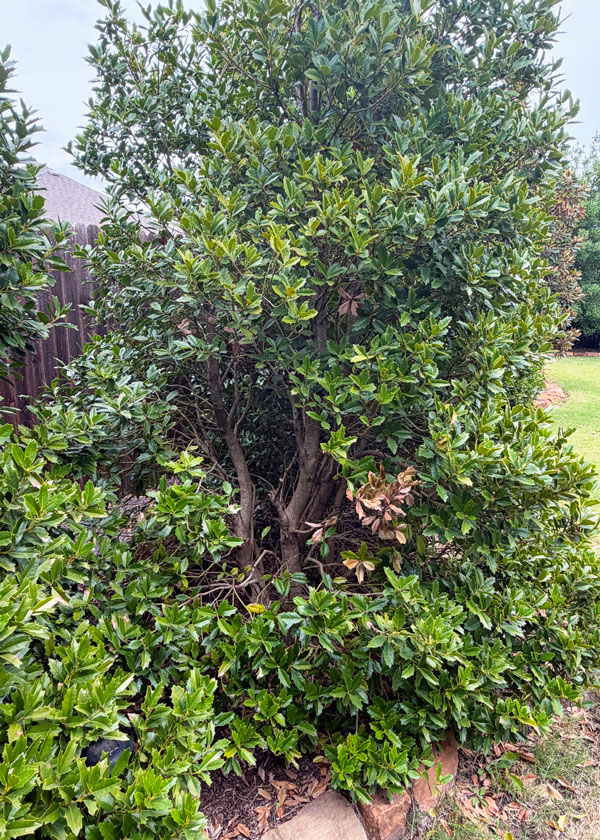
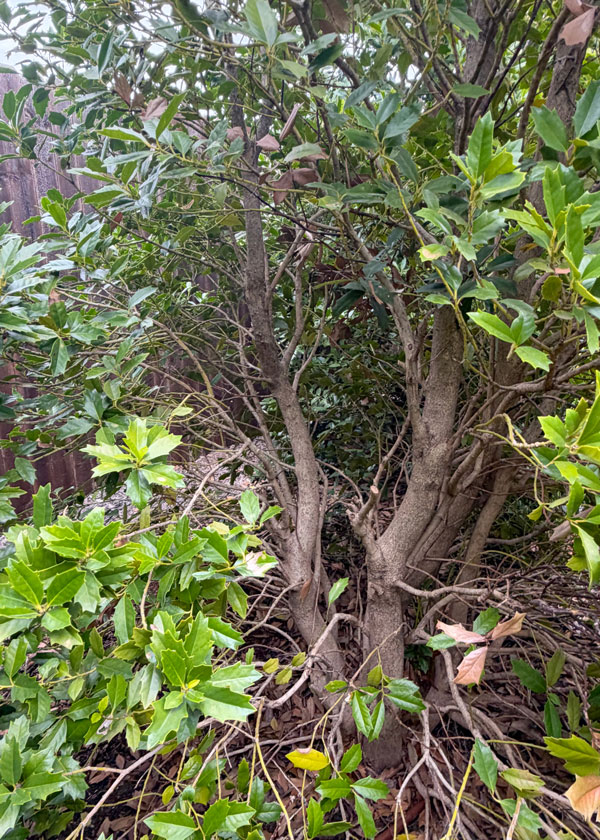
Images clickable for larger views.
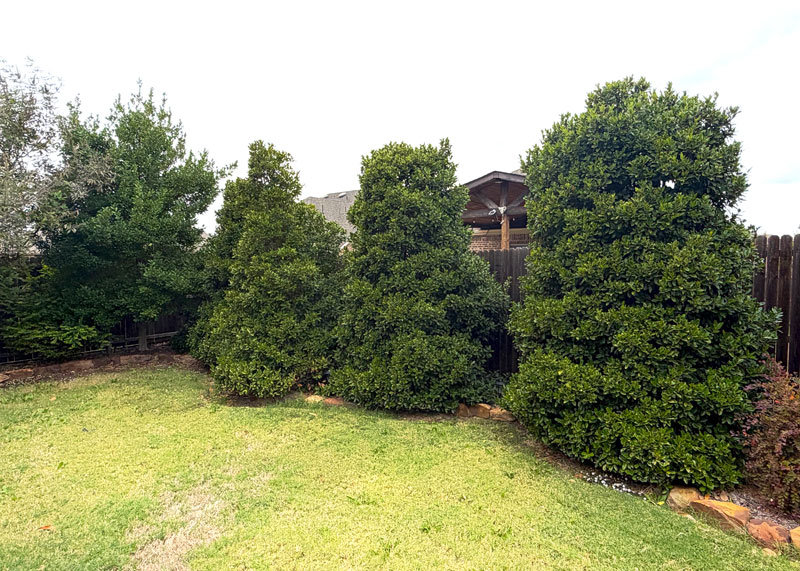
Answer: Overall, your four hollies look fabulous. When I read your question beforehand, I worried that they might have gotten too dry. That might still be the case. The turf looks like it might have been on the dry side.
For what it’s worth, I have had individual hollies lose branches without explanation. Usually, it has been due to effects of letting them get slightly too dry. Most commonly it’s been due to problems with my sprinkler system.
In your case I think your affected plant will recover if you’ll give it a high-nitrogen fertilizer in early March followed by thorough soakings on a regular basis.
QUESTION 5
WHY IS MY LAWN BARE?
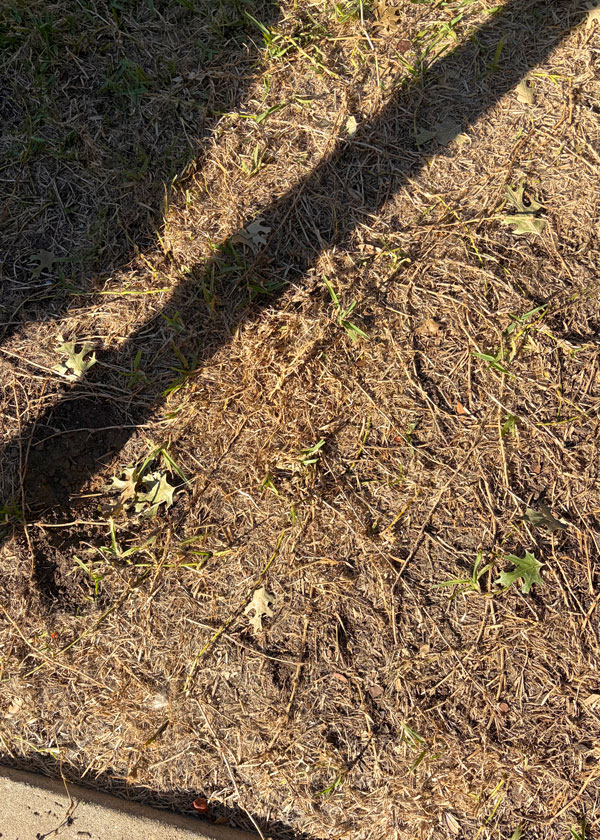
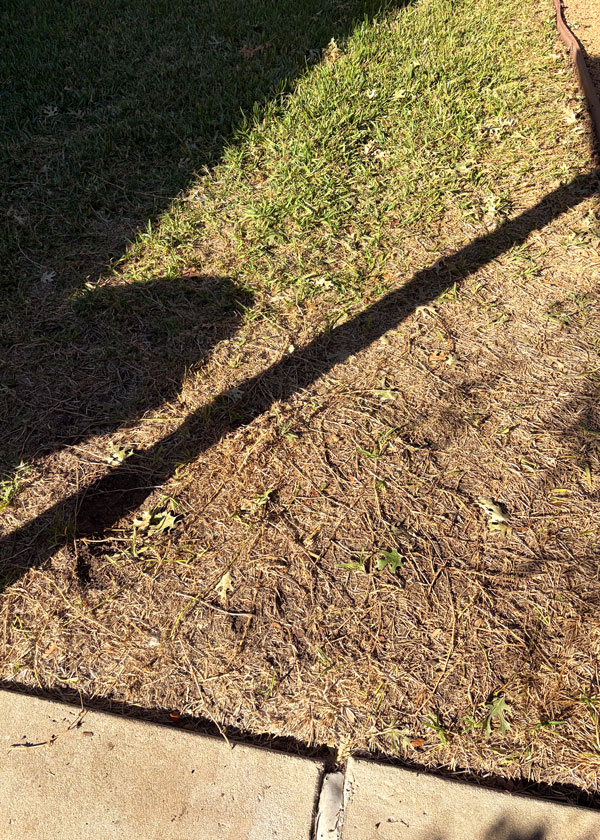
Question: Brown patch? Take all? Something else? When should I treat it? Suggestions? It was thin last year. I think it was from my dog spinning around there, and I put plugs in. It filled in really well, and now this is with no dog traffic. James H., Plano.
Images clickable for larger views.
Answer: Well, James. I really can’t tell at all. Your photos both show essentially the same area very close in and cut very short. It doesn’t look like there has been any thick St. Augustine in this area anytime in recent months. Brown patch wouldn’t look like this, and I don’t think take all patch would either. I wish I had a photo of the entire area.
How much sunlight does it get? That shade looks intense. No grass is going to grow in that. This doesn’t look like chinch bugs, either, again because there doesn’t appear to have been any St. Augustine there for them to have killed.
Here would be my suggestion. If this area gets 6 or 7 hours of direct, hot and intense summer sun all growing season long, I would try sodding it next April or May. Be sure you prepare the soil carefully prior to planting, then keep it properly watered so it doesn’t wilt and die.
I really can’t tell you anything more. I wish I could, but there just aren’t any symptoms in the photos for me to “read.”
QUESTION 6
IS THIS CRABGRASS?
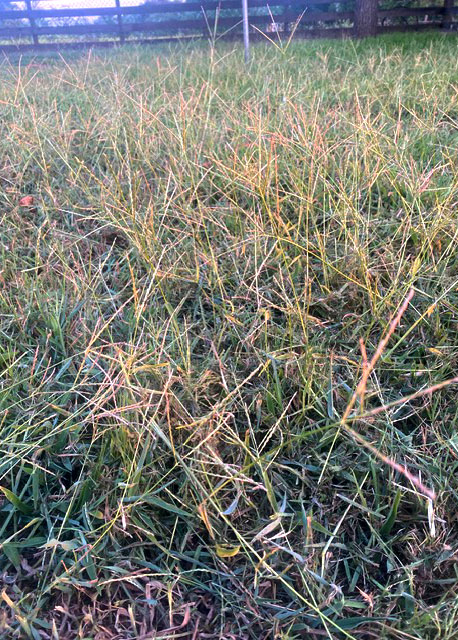
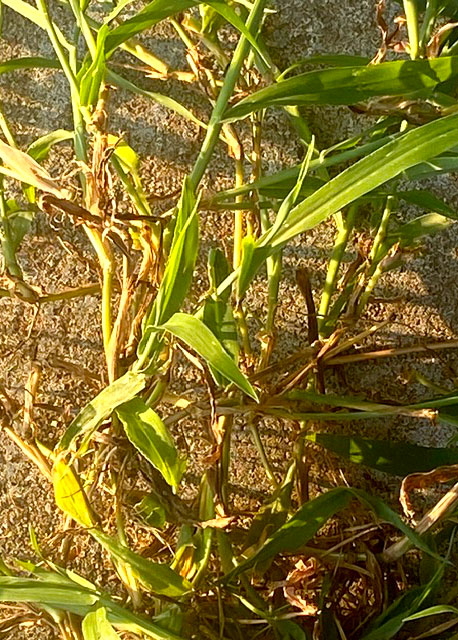
Question: We have very sandy soil, and this summer our St. Augustine and bermuda lawn has been overtaken by this weed. I believe it’s crabgrass. What is the best way to eliminate it? David B., Madison County.
Images clickable for larger views.
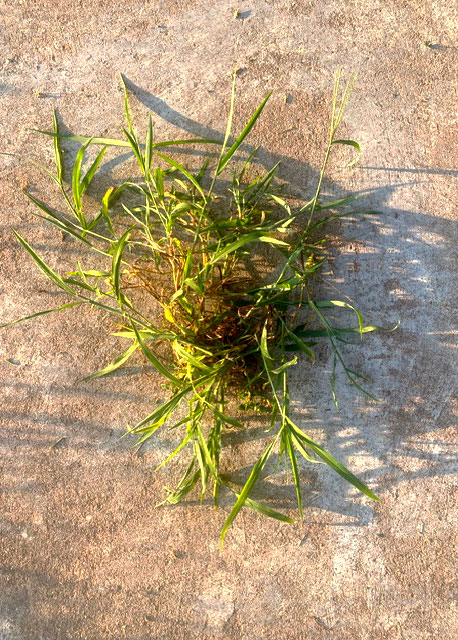
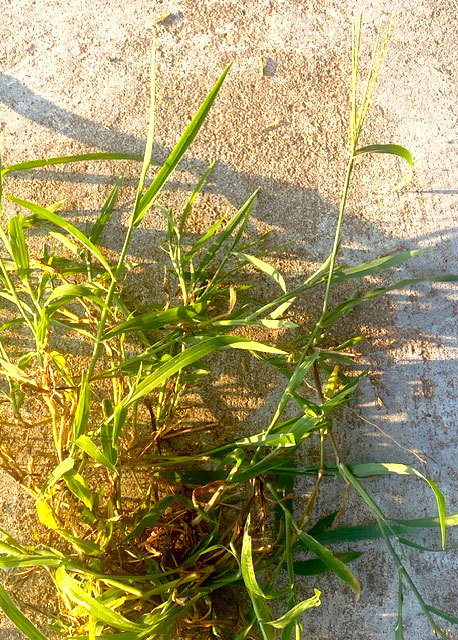
Answer: Yes, this is crabgrass. It is a warm-season annual grassy weed, which means that application of a pre-emergent weedkiller prior to germination in the spring and early summer is your best approach. There is no product that will get rid of it once it is growing vigorously within a combination lawn.
Apply Dimension or Prodiamine granules two weeks prior to the average date of the last killing freeze for your county. Your county Extension office can confirm that date, but the sources I found online say March 17 is your average date of the last killing freeze in Madisonville. (Honestly, I would have guessed a week or two earlier.) That would make your first application date around March 3.
Because our growing season in Texas is so long you would need a second application 90 days later. That would put you into the first week of June.
In the meantime, all those dried seedheads you see in the one photo are going to be sowing seeds for next year. (Yikes!) You would be well advised to mow more often and keep them clipped off before they can develop. Take the best possible care of your lawn in terms of water and fertilizer and the St. Augustine alone should crowd out the crabgrass.