
Q&A – Ask Neil: October 29, 2026
(Please read these instructions carefully.)
Before you post your question, please look at recent issues to see if someone else has already asked it. You might find your answer there.
HOW TO SUBMIT YOUR QUESTION…
• Click here to post your question. (Please post your question only one time.)
• Please use this link only for posting questions – not for standard e-mails.
• High-resolution photos (1-2MB – not thumbnails) attached with your question help Neil give you the best possible answer. Please check your photo for clarity and exposure. If you do not see “All images clickable for larger views,” your images’ resolution was not sufficient for enlargement. That might also have made it difficult for Neil to give you an accurate answer.
• Neil chooses questions of greatest reader interest. Plant IDs rarely fit that description.
• Neil requires your first name or initials, also your city or county for an accurate answer. (Texas is a very large state.)
• One question per reader per week, please.
• Watch for Neil’s reply in the next issue of e-gardens.
Note: If you have submitted your question and did not see the pop-up window for attaching your photo, please click here.
QUESTION 1
IS IT TOO LATE TO APPLY PRE-EMERGENT GRANULES AND TO FERTILIZE MY LAWN?
Question: Is it too late to apply pre-emergent granules to my lawn (one from Fort Worth, another from McLennan County/Waco area), also to fertilize the grass?
Answer: This question came almost verbatim back-to-back as soon as we opened the Q&A lines up last Thursday. I’m answering them together. My reply applies to the entire state.
Yes, it’s too late for pre-emergent granules. Because September was so hot the application time slid back by a couple of weeks, but by the end of September it was last call for pre-emergents.
As for feeding, the answer for St. Augustine and bermuda is the same. Too late. If, however, you’re feeding ryegrass or fescue, those are both cool-season grasses that can be fed now. Apply a high-nitrogen fertilizer with 30 to 40 percent of its nitrogen in slow-release form. But for the warm-season grasses, wait for their next feeding to come as growth resumes in late March or April, earlier in South Texas, later in the north.
One of you implied you wanted to use a low-nitrogen, high-potassium product. That would almost never be the recommended combination. Whether a soil is clay or sand, nitrogen (first number of the 3-number analysis) is always going to be the prime recommendation. Rarely, in very sandy soils, phosphorus (middle number) might be suggested. Potassium, the third number, is rarely deficient to the point that we need to worry about adding it specifically.
QUESTION 2
WHAT WOULD HAVE KILLED MY BERMUDA BUT LEFT THE ST. AUGUSTINE INTACT?
Question: There is a portion of my lawn where the bermuda has some type of problem. St. Augustine nearby is doing fine. What is wrong and what should I do? Pat T., Bexar County.
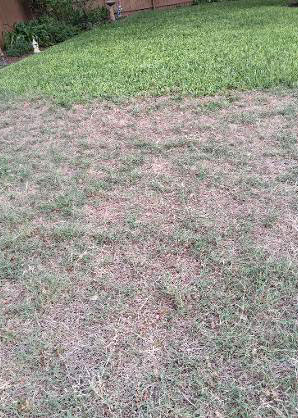
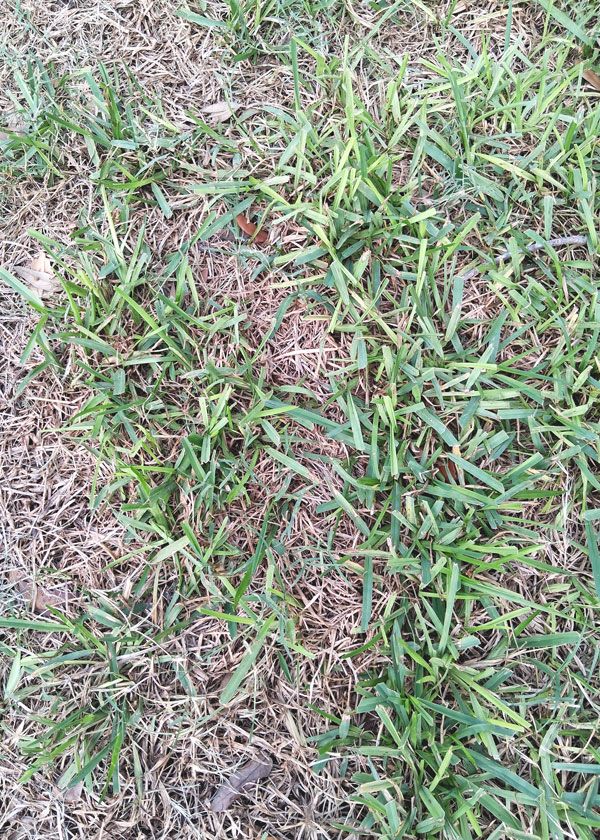
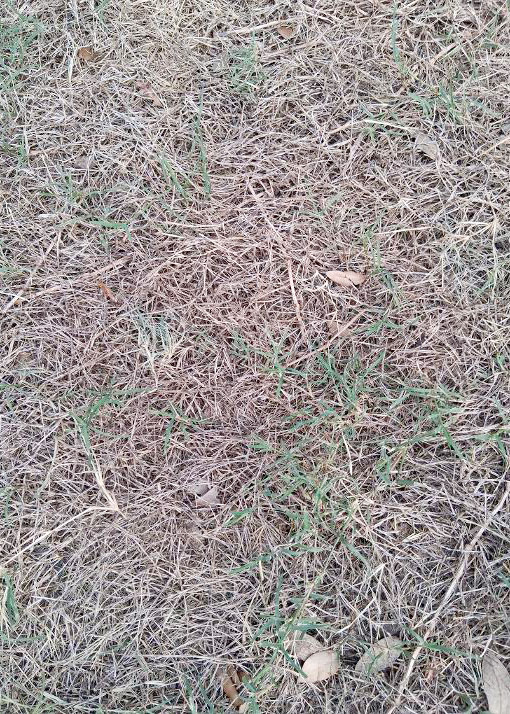
Images clickable for larger views.
Answer: That’s just the opposite of what usually happens when these two grasses grow together. St. Augustine usually has the issues.
I can only speculate. Bermuda’s prime issue in late summer and fall is cottony blight (pythium). It’s unusual for it to take an entire area like your one photo shows, but I don’t know of anything else to suggest. Pythium usually crops up where bermuda turf stays too wet and where fertilizer collects in excess. If this area is slightly lower than the rest, that could be the case.
It’s also possible you used a weed-and-feed product such as atrazine that is intended for use only on St. Augustine. It would have done damage to the bermuda while not bothering the St. Augustine. Read the label of any product you might have applied. You might uncover the cause. If so, you’ll just have to wait it out. It will eventually leach out of the soil.
QUESTION 3
WHAT SMALL TREE WOULD LOOK GOOD IN THIS SPOT?
Question: We lost a very large Shumard red oak due to oak wilt. We are on 7 acres. What small tree would fit this location well? Yaupon holly, Nellie R. Stevens holly, Willowleaf holly – any of those trained tree-form, or Mexican plum? Recommendations? Birdie J., Hudson Oaks, Parker County.
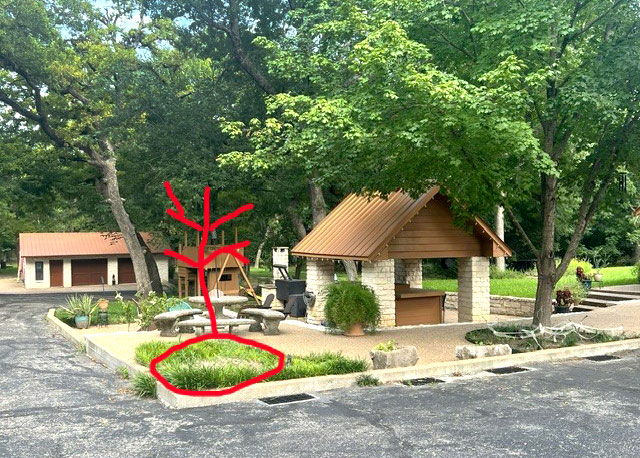
Answer: I like your holly ideas, and of them yaupon, Willowleaf, or Nellie R. Stevens would be my choices. Mexican plum would get too tall and it probably would become very lopsided. Warren’s Red possumhaw holly would be beautiful, even though it’s deciduous. Nurseries that sell to landscape contractors could find you a large specimen of any of the hollies in a container.
QUESTION 4
HOW SHOULD WE PRUNE OUR VITEX?
Question: Our vitex has many branches extending out. Should we prune it to one or two major trunks or leave it alone? Melanie M., Bryan.
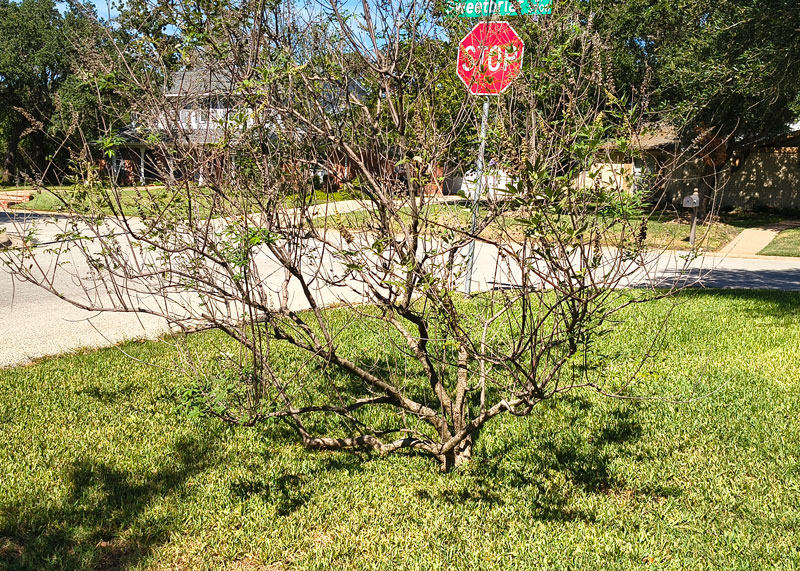
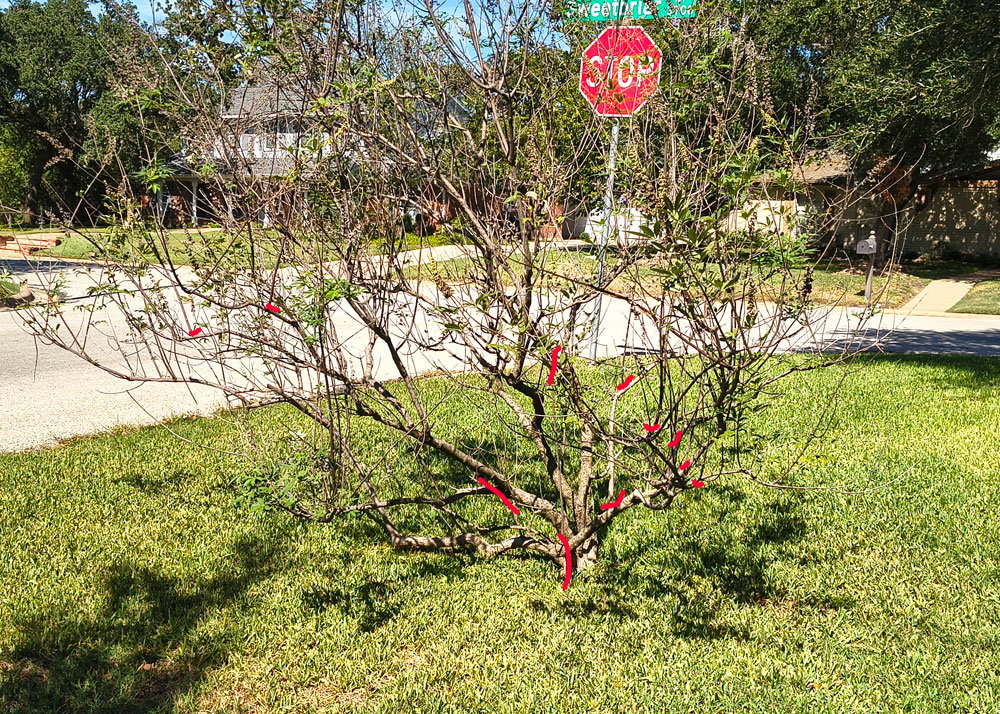
Answer: I’ve grown vitex (lilac chaste trees) almost all my life, and I’ve found them to be some of the most challenging shrubs to turn into small, multi-trunk trees. Look at how tangled their branching can be. You hardly know where to start and when to stop.
I played around a little with the “line” tool in Photoshop and drew a few marks where I might suggest removing branches. I would trim away the two lowest branches going off to the left. However, it’s difficult to see exactly how the lowest branch could be cut. Just try not to leave any stubs.
I also see many small branches, even twigs where small stubs have been left and odd shoots have developed. I would probably thin out a bunch of these. I marked a few of them, although it’s hard to tell exactly which ones without being there on site.
My suggestion would be that you prune them away one or a few at a time, then step back to see how the plant looks before you cut any more. I would leave it shrub-form. There seems to be no clear path to a tree from this beginning.
Hope that helps.
QUESTION 5
WHAT DO I DO WITH MY CRAPE MYRTLE CUTTINGS OVER THE WINTER?
Question: I rooted these cuttings from a crape myrtle in Austin in July. I mist them morning and evening and I cover them with plastic bags for a greenhouse effect. How large do they need to be before I plant them into the ground? How do I overwinter them if I need to wait to plant them? Laura B., Abilene.
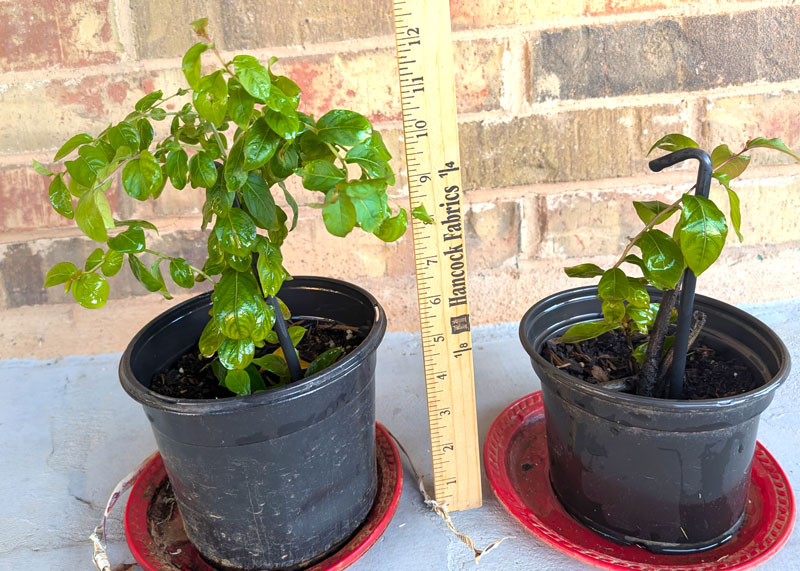
Answer: You have done well. You can remove the plastic bags now and stop the misting. They need to toughen up. They have roots and need to acclimate to fall weather so they can drop their leaves normally.
They are not ready to be planted into the ground in Abilene. However, they also cannot be left in pots outdoors during the coldest winter weather. I would put them where you can set them into the garage or a similar setting when temperatures will drop below freezing.
If you have access to a greenhouse, that would be fine, even if they held their leaves all winter. Just don’t expose them to freezing weather if they’re still growing.
That gives you a couple of options. You should be able to plant them into the ground by late spring, but put stakes on either side of them to protect them from kids and pets so they don’t get broken.
QUESTION 6
WHAT KILLED OUR VARIEGATED ABELIA, AND WILL IT COME BACK?
Question: This variegated abelia died suddenly. We wonder if we cut it back all the way if it will come back? What would have killed it so quickly? Karen D., Midland.
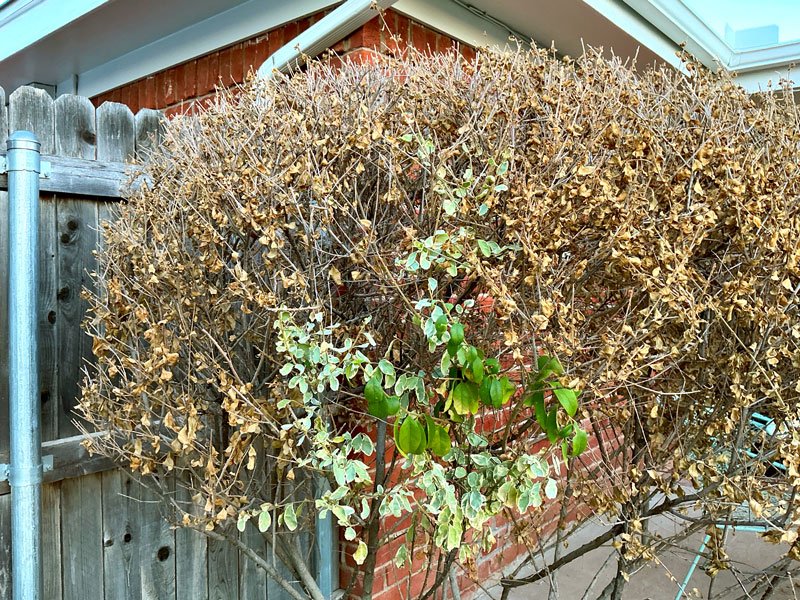
Answer: This is variegated privet, not an abelia. As such, it’s not of the same high quality as a landscape shrub. Variegated privet tends to revert to plain green (as you can see), and unfortunately it will bloom and set seed. Birds will eat the fruit, and seedlings will begin to invade your landscape. Plus, the plants get very large and unruly.
I think cotton root rot, a soil-borne fungus killed this plant. It strikes very quickly as you described. There is no preventive measure nor is there a cure.
Your best bet is to replace the plant with a resistant species. If this were my landscape, I’d go with dwarf Burford holly. It’s evergreen, deep glossy green with bright red berries all winter. It’s a great plant that grows to 4 to 5 ft., 6 ft. with extreme age and if left unpruned. It’s also highly resistant, if not immune, to cotton root rot. All you must do is keep it watered deeply a couple of times per week until the plants become established – generally 2 to 3 years.