
Q&A – Ask Neil: October 22, 2026
(Please read these instructions carefully.)
Before you post your question, please look at recent issues to see if someone else has already asked it. You might find your answer there.
HOW TO SUBMIT YOUR QUESTION…
-• Click here to post your question. (Please post your question only one time.)
-• Please use this link only for posting questions – not for standard e-mails.
-• High-resolution photos (1-2MB – not thumbnails) attached with your question help Neil give you the best possible answer. Please check your photo for clarity and exposure. If you do not see “All images clickable for larger views,” your images’ resolution was not sufficient for enlargement. That might also have made it difficult for Neil to give you an accurate answer.
-• Neil chooses questions of greatest reader interest. Plant IDs rarely fit that description.
-• Neil requires your first name or initials, also your city or county for an accurate answer. (Texas is a very large state.)
-• One question per reader per week, please.
-• Watch for Neil’s reply in the next issue of e-gardens.
Note: If you have submitted your question and did not see the pop-up window for attaching your photo, please click here.
QUESTION 1
WHEN IS THE BEST TIME TO ADD SOIL INTO HOLES MADE BY ARMADILLOS?
Question: You helped me earlier about armadillos in our yard. When is the best time to add soil where they were? Ava W., Robertson County.
Answer: If you are just adding soil to fill the small holes the armadillos dug into the turf, that should be done right away – the next day after the damage shows up during the growing season.
If you’re talking about filling in their tunnels where they live, hide, and hibernate, that’s different. Once you have captured your armadillo in the humane trap as I have described a couple of times here, you can fill the tunnel at any time. However, those tunnels are deep. They seem to go on forever. Soil you add may settle and wash into the tunnels creating renewed voids. It may take a while to get the problem corrected. In the meantime, you may be revisited by a new generation of armadillos in the next year or two. Usually, those tunnels are well hidden behind shrubs, against the house or beneath retaining walls. These animals are devious.
QUESTION 2
WHERE CAN I FIND PRODUCTS WITH GLYPHOSATES?
Question: You have mentioned using a weedkiller with glyphosate. The products on our shelves where I work do not contain it. What is an alternative, or where can I send my customers to find it? Joel M., Euless.
Answer: The Fertilome/Hi-Yield people have it in consumer products as Hi-Yield Super Concentrate Kill-Zall Weed and Grass Killer Super Concentrate (41.0%). Farm supply dealers also list other brands. It is definitely still out there. I bought it carefully to eliminate bermudagrass in a groundcover bed at our house just a few months ago. As you know, its advantage is that it does not leave residue in the soil. In fact, it is not active in the soil. It only kills by contact with foliage.
QUESTION 3
DO I NEED TO WORRY ABOUT MY GOLDEN RAINTREE AND THIS FUNGUS?
Question: This mushroom is growing from a knothole in the trunk of my 30-year-old golden raintree. I scraped the fungus out last summer and sprayed the hole with tree paint, but the fungus just reappeared. Do I need to worry? This happened before I learned how to prune properly from you. Karl F., Grand Prairie.
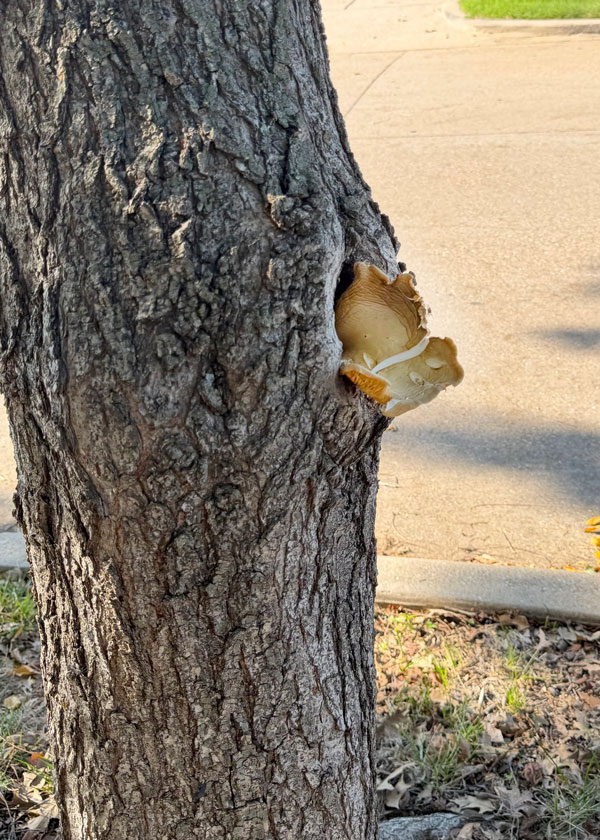
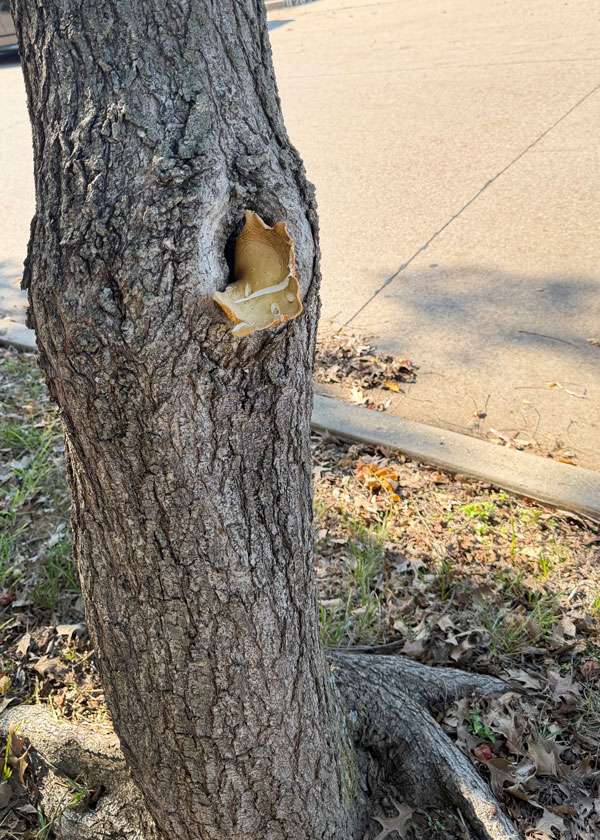
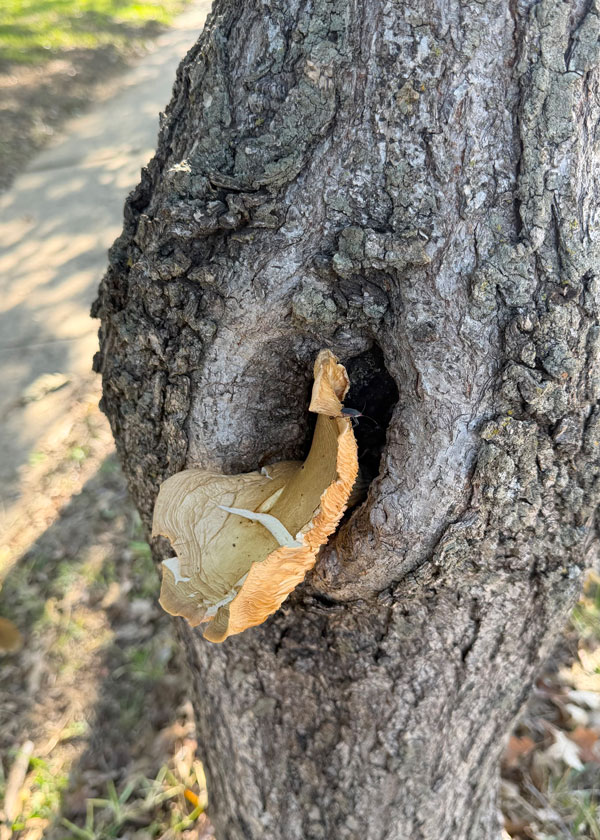
Images clickable for larger views.
Answer: This type of bracket fungus generally develops when there is decaying wood within a tree’s trunk. You can see it from the dark tissues within the knothole.
The overall vigor of the top of the tree will tell you a lot. Decay often becomes worse on the hole side of the trunk and the top growth on that side begins to thin and die. As you see that happening you need to be concerned. That’s when the tree will have lost enough of its trunk strength to hold itself upright. Your photos did not show any part of the canopy so I couldn’t tell.
A certified arborist with Tree Risk Assessment Qualification (TARQ) would have the best idea in an on-site observation. It would be wise to have them out before the tree starts losing leaves this fall. Our advertisers here, Arborilogical Services, do serve your area and probably could help. Until you can determine the extent of the decay do not park near the tree and avoid any activities near it.
Further, do not attempt to clean out the wound. Do not seal it with more pruning paint, and do not fill the void with cement or any other substance.
Incidentally, if you do have a certified arborist look at your tree, point out the roots and their odd configuration. Hopefully they’re not causing problems of their own.
QUESTION 4
HOW CAN I STOP THIS LAWN WEED?
Question: I can’t conquer this lawn weed. It looks like miniature ferns. It has spread across an area 20 x 40 ft. during the summer. What will eliminate it? I’ve used 2,4-D. Mike S., Murphy, Collin County.
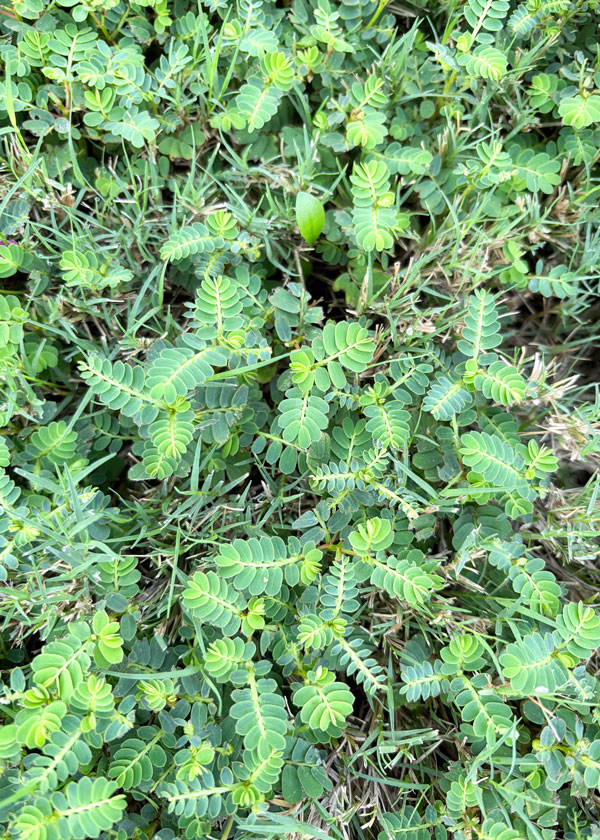
Answer: It’s one of the less common lawn weeds (in my experiences) called chamberbitter (Phyllanthus spp.). It’s a warm-season annual weed that germinates once soils warm in the spring and proliferates all summer and into the fall. You should be able to see its numerous small seeds attached beneath the leaves as the stems mature over the next several weeks.
The university recommendations I found online call for just what you used: 2,4-D in any of the 3-way combinations also containing MCPP and dicamba – generally labeled as “Trimec.” I also found references suggesting atrazine when the weed is growing in St. Augustine turf, but I’ve made it my practice not to recommend atrazine because of the hundreds (probably thousands) of mature shade trees I have seen damaged and killed by atrazine when people misapplied it over their root systems.
QUESTION 5
WHAT CAUSED THE CRACK IN THE TRUNK AND WHAT CAN BE DONE?
Question: We have an eastern redcedar that is about 44 years old. It has a crack in one of the trunks near a fork in the tree. The crack is 5 in. deep and about 1 ft. long. What can be done to prevent its getting any worse? The steps nailed into the tree have been there a long time. I don’t believe they’re the cause of the crack. Also, we have an appointment with Arborilogical Services scheduled for next Tuesday.
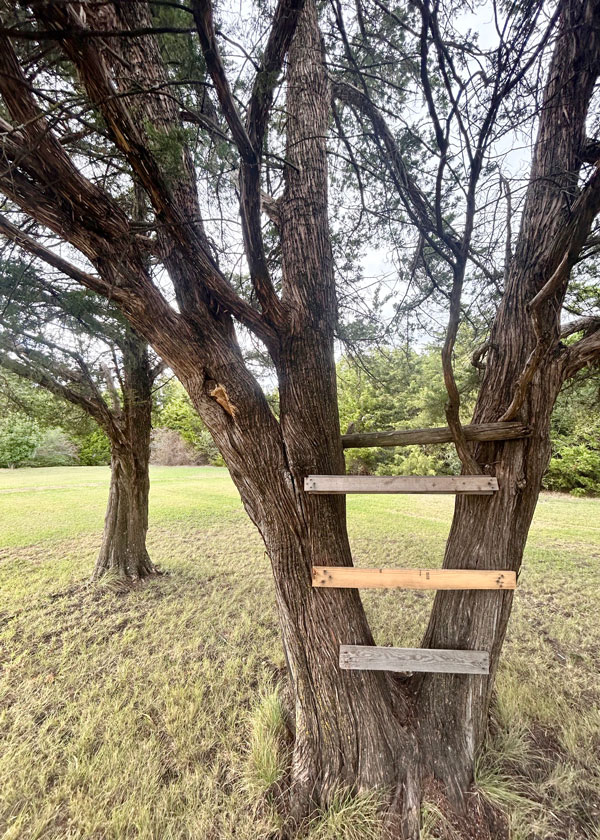
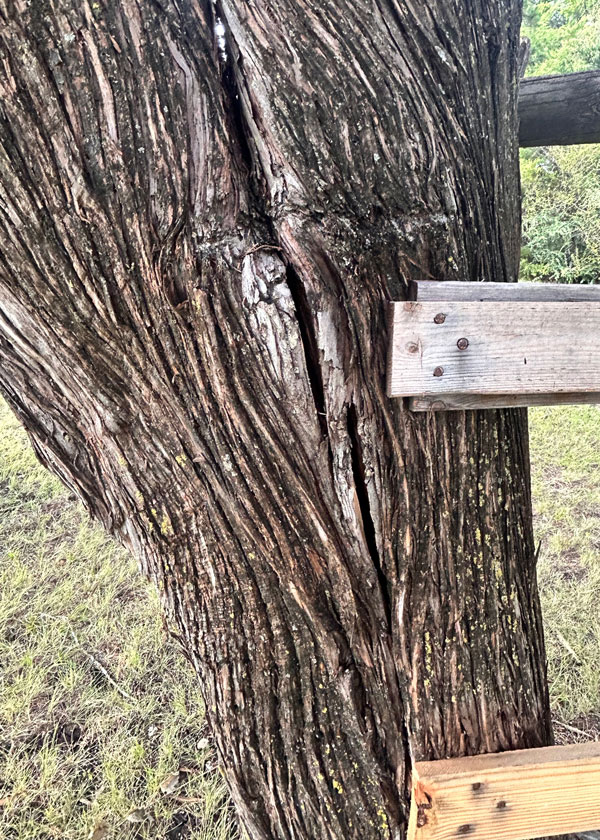
Images clickable for larger views.
Answer: I guess the folks from Arborilogical Services will get to validate or reject any idea I put out here now. I’m fine with that, and their opinion trumps anything I suggest.
The crack is in an outward-facing branch. My bet would be that it happened during a snow or ice storm years ago, and I would suggest that the portion to the outside (left side in your photo) picked up enough extra weight to cause the crack to develop. It all may have happened at once, or it could have gotten worse over the ensuing years. Talk to them about whether cabling the two parts of the side with the split together 8-10 ft. farther up might be a long-term help. They may also suggest drilling completely through the trunk at right angles to the split and inserting a piece of all-thread rod to hold it together. They will know how to do that as well as having the necessary parts and equipment. Or they may feel it’s not necessary once they see the extent of the split.
Oh, and I agree with you. I don’t think the steps had anything to do with the split.
QUESTION 6
WHAT IS WRONG WITH MY ST. AUGUSTINE?
Question: My St. Augustine has never looked so bad. What is wrong with it, and what can I do? Randy M., Dallas.
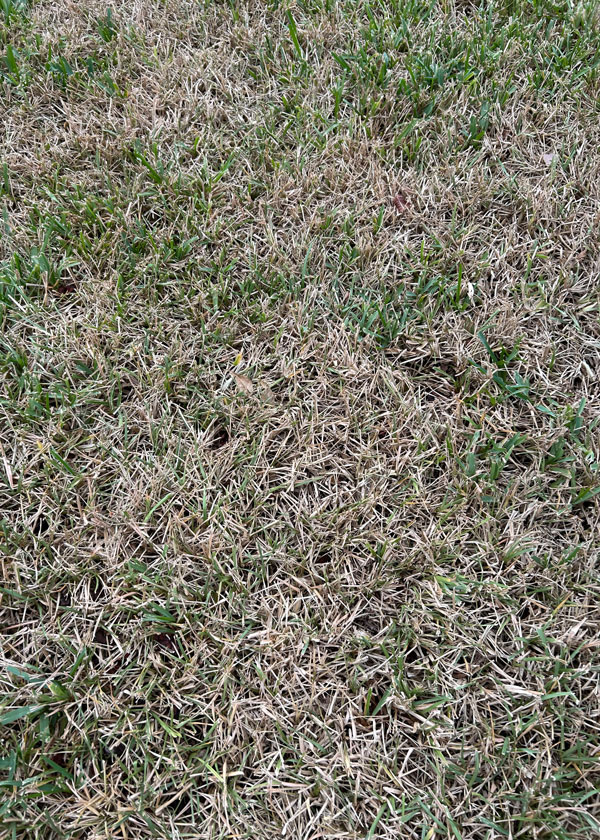
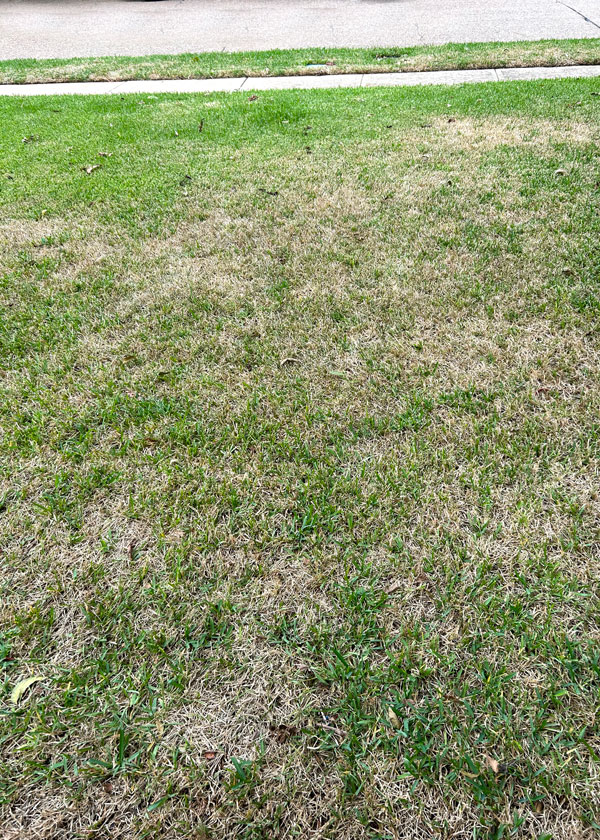
Images clickable for larger views.
Answer: If I look closely at your more distant photo, I can see what appears to be brown patch circles. That particular fungus causes the grass to turn yellow, then quickly brown in patches 18 to 30 in. in diameter. It shows up in the fall, usually from late September through the first frost. I’ve already had several questions about it here. You’ll see that I have addressed it in my Texas Garden Tip in this issue.
The quickest way to tell for sure if brown patch is involved is to tug gently on a handful of the browned blades in several of these areas. If they pull loose easily from the runners, and if they are decayed at their bases – where the blades attach to the runners, that’s brown patch. It attacks only the leaves of the grass. If it stays warm for a few more weeks you should see green leaves starting to emerge in the browned areas.
If that’s not the issue, then this could be leftover damage from chinch bugs or gray leaf spot, but in those cases the lawn would have looked bad for 2-3 months and I would have expected your question to have shown up much sooner.
QUESTION 7
WHAT CAN WE DO FOR THIS UNATTRACTIVE NEW GROWTH ON A CHINESE PISTACHIO?
Question: My dad had two Chinese pistachios planted a few years ago. One of them died. The closer one is the replacement. It has some abnormal vertical growth that is not very attractive. I know we’re not supposed to “top” a tree, but what else can we do? Michael G., Mansfield.
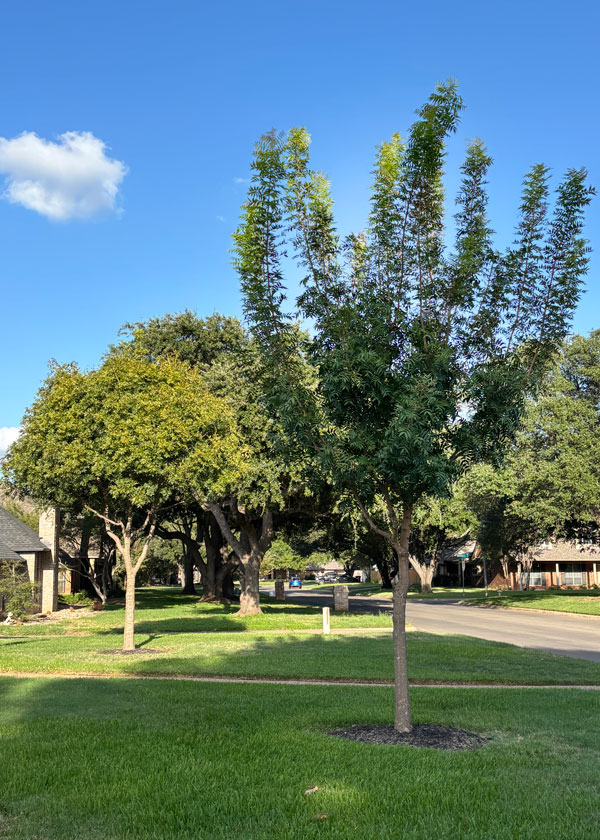
Answer: I have always cautioned people that young Chinese pistachios look like “gangly puppies.” You are showing a perfect example. I have grown them, and I know exactly how you feel. I had the same experience with mine, and I used a long-handled tree pruner to nip the tips out of my tree to force it to branch. In your case I would suggest removing the tip 12-15 in. off those branches. Basically, you’ll want to round it off but vary the heights a little bit so it doesn’t look so intentional. It will send out a couple of new branches from each cut end and the tree should fill in normally. This should be just a one-time process. It should look very normal by next summer.