
Q&A – Ask Neil: November 12, 2026
(Please read these instructions carefully.)
Before you post your question, please look at recent issues to see if someone else has already asked it. You might find your answer there.
HOW TO SUBMIT YOUR QUESTION…
• Click here to post your question. (Please post your question only one time.)
• Please use this link only for posting questions – not for standard e-mails.
• High-resolution photos (1-2MB – not thumbnails) attached with your question help Neil give you the best possible answer. Please check your photo for clarity and exposure. If you do not see “All images clickable for larger views,” your images’ resolution was not sufficient for enlargement. That might also have made it difficult for Neil to give you an accurate answer.
• Neil chooses questions of greatest reader interest. Plant IDs rarely fit that description.
• Neil requires your first name or initials, also your city or county for an accurate answer. (Texas is a very large state.)
• One question per reader per week, please.
• Watch for Neil’s reply in the next issue of e-gardens.
Note: If you have submitted your question and did not see the pop-up window for attaching your photo, please click here.
QUESTION 1
IS THERE A PRE-EMERGENT I CAN USE ON A GROUNDCOVER BED?
Question: I either have Asian jasmine or vinca groundcover (not sure which). Is there a pre-emergent weedkiller I can use in the bed early next spring to stop weeds that won’t hurt the groundcover? Dan F., Cleburne.
Answer: Dimension pre-emergent weedkiller granules have exactly the label clearance you’re describing. Dimension can be used on turf, and it’s also cleared for use around ornamental trees and shrubs and in established groundcover beds to prevent germination of annual weeds. Apply the granules 2-3 weeks prior to the average date of the last killing freeze in your area. (Double check it for me, but that’s going to put you somewhere around March 5-20.) Repeat the application 90 days later.
I might add that, concurrent with those applications, you’ll also want to fertilize and water the groundcover to help it cover into a thick mat. That will discourage weed growth in future years.
Do a little checking on the plant itself. Vinca groundcovers are pretty uncommon unless you’re in an older neighborhood (It’s not very popular any more.) and unless you’re dealing with a very shady area. Asian jasmine is the most popular groundcover in Texas, especially where the sun is intense. It’s also quite glossy – more so than vinca. Vinca would also have blue flowers in the spring.
QUESTION 2
WHY WOULD SAVANNAH HOLLIES DIE AFTER 13 YEARS?
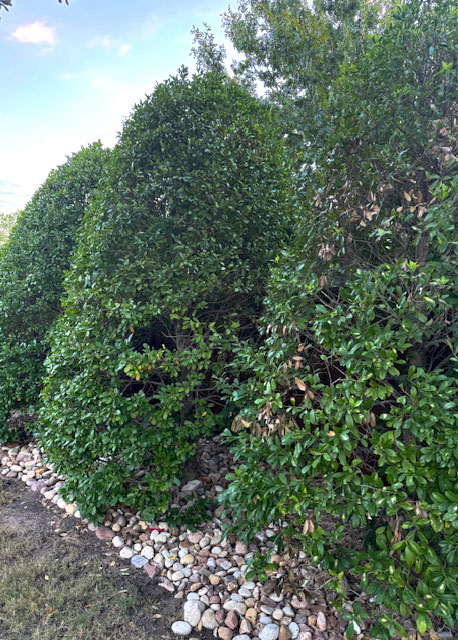
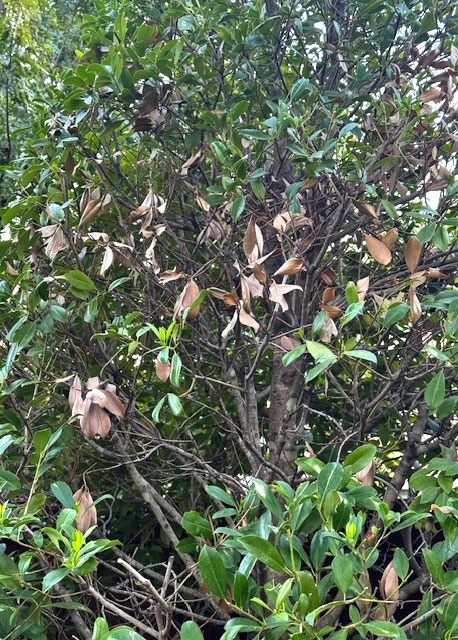
Question: Thirteen years ago, I had 6 Savannah hollies planted along the fence line. Two years ago one died. The plants on either side were thriving. Now, a couple have a dead branch or two. I’m afraid I might lose more. What should I do? Stephen L., Rowlett, Dallas County.
Images clickable for larger views.
Answer: Savannah hollies are not fond of the alkaline black clay gumbo soils of the DFW Metroplex and along I-35. It’s quite common for them to struggle after 5 or 6 years. I also live and work in the same general area and I’ve noticed how few you see that are 10 or 15 years old and still doing well. It’s because of iron shortages due to the alkaline ground also to the low humidity compared to the East Coast and even East Texas where these large hollies are better suited.
That said, this year’s heat and drought probably also played a role in your plants’ struggles. Anything you can do to add iron and sulfur soil acidifier to their root zones and to keep your plants moist and growing vigorously will be good. Apply a high-nitrogen lawn-type fertilizer to them in early spring, early summer and early fall. Follow each feeding with a deep soaking.
It might also help if you could relax on the repetitive shearing just a bit. Each time that we do that we trim off the newest growth. Essentially that penalizes the plant for trying to put out new growth. Eventually it runs out of steam.
Oakland, Nellie R. Stevens, and Mary Nell hollies would be good alternatives if it ever comes to that. Hopefully it won’t.
QUESTION 3
WHEN SHOULD I PRUNE MY HYBRID TEA AND BUSH ROSES?
Question: When should I prune my hybrid Tea and bush roses? Barb B., Springtown, Parker County.
Answer: Roses are pruned the first two weeks of February. Each cut should be made just above a bud facing out from the center of the plant.
The exception to that timing would be any rose that only blooms in the spring. In its case, you would trim it immediately after it finishes blooming. Pruning earlier would be a big mistake as you would be trimming away buds it was starting to set.
QUESTION 4
HOW CAN I GET MY BOUGAINVILLEA TO BLOOM BETTER?
Question: I have this bougainvillea in front of my salon. This is its second year here. (It made it through the winter outdoors!) It doesn’t bloom until the end of October going into November. Is this normal? Kathy N., Hewitt.
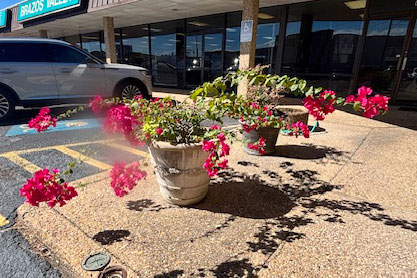
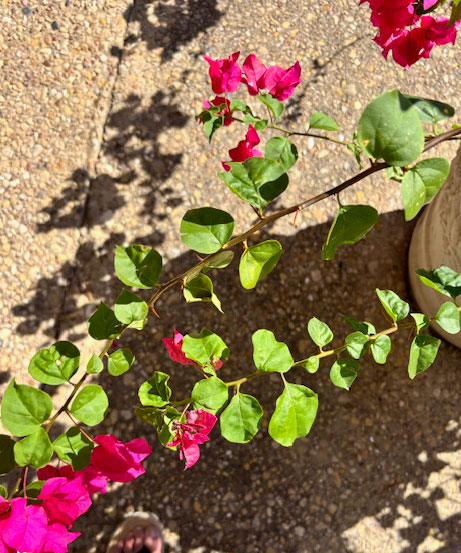
Answer: It’s not normal, but it’s not uncommon. What’s really not normal is for a bougainvillea to survive a winter in your area in a pot. I would never have guessed that.
Your plant was probably weakened by its exposure to the cold last winter. If you can protect it in a warm, sunny place this winter, then put it back in place in full sun next spring, it’s more likely to reward you with blooms next May and June.
Bougainvilleas bloom best when they’re slightly rootbound, and they usually flower best as they come out of dormancy, whether that’s brought on by winter’s color or summer’s heat. The latter is why your plant has bloomed in the fall each year.
QUESTION 5
DOES TIMING FOR LIVE OAK PRUNING CHANGE BECAUSE OF OUR HOT FALL?
Question: I have a 6-year-old live oak in the front yard. I want to trim some very low-hanging branches. Does the trimming advice change if we’ve had a really hot early fall? I don’t want to put my tree at risk. Is it OK to prune my live oak now? Bill T., Waco.
Answer: So all will understand, the issue here is the fungus oak wilt. It is spread from its fungal mats that are active while susceptible oak species are growing vigorously in the spring.
Foresters and plant pathologists have determined that we need to avoid pruning our oaks from mid-February through mid-July. (Certified arborists are an exception, as they know proper ways to handle oaks when they must be pruned at those times.) Once it turns really hot in mid-summer you are fine to resume pruning, and you can continue on through fall and until mid-February of the following year.
Yes, you are OK to prune now. Remember that you should always seal cuts the size of your finger or larger with pruning sealant or latex paint.