
Q&A – Ask Neil: November 19, 2026
(Please read these instructions carefully.)
Before you post your question, please look at recent issues to see if someone else has already asked it. You might find your answer there.
HOW TO SUBMIT YOUR QUESTION…
• Click here to post your question. (Please post your question only one time.)
• Please use this link only for posting questions – not for standard e-mails.
• High-resolution photos (1-2MB – not thumbnails) attached with your question help Neil give you the best possible answer. Please check your photo for clarity and exposure. If you do not see “All images clickable for larger views,” your images’ resolution was not sufficient for enlargement. That might also have made it difficult for Neil to give you an accurate answer.
• Neil chooses questions of greatest reader interest. Plant IDs rarely fit that description.
• Neil requires your first name or initials, also your city or county for an accurate answer. (Texas is a very large state.)
• One question per reader per week, please.
• Watch for Neil’s reply in the next issue of e-gardens.
Note: If you have submitted your question and did not see the pop-up window for attaching your photo, please click here.
QUESTION 1
HOW CAN I DETERMINE THE AGE OF MY LIVE OAK TREES?
Question: How can I determine the age of my magnificent live oak trees? (Example of one in my photo.) Our houses in our neighborhood were built in 1978, but the trees obviously were not planted from acorns then. This one appears to be 34 in. in diameter. Tim B., Plano.
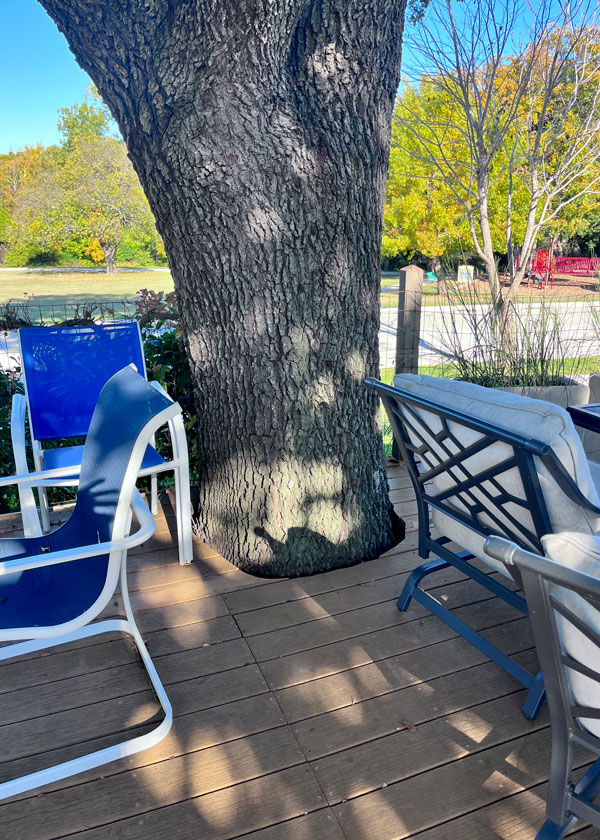
Answer: That’s almost 50 years ago, so we can start with that number. Add to it whatever age the trees were when the builder gave the landscaper instructions on their purchase.
I was working around Plano at that time. In fact, we had just moved to rural Collin County a few miles north of you a few months earlier and I was buying plants for my own landscape, so I was paying close attention to what was being sold. Most of the new houses were getting trees that I would estimate to be 5 to 10 years old. Some of the West Plano neighborhoods around Willow Bend of course, got much larger trees.
I would guess that your tree in your photo is probably 60 years old. I have two large native red oaks and one large native pecan that were along our drive when we built. All were approximately 6 to 8 in. in diameter at that time and now, 50 years later they are 30-35 in. in diameter and 50 ft. tall. They are massive. We live in a pecan and red oak forest, but I recall those three trees in particular because they are so close to our drive and house.
But this is all based on experience and observation. Look for old photos of your house or your neighborhood. If you have a certified arborist looking after your trees, ask them. The only reasonably sure way would be to have a boring done to count the rings and I doubt if you want to go to that expense.
QUESTION 2
HOW AGGRESSIVE ARE FLAMELEAF SUMACS?
Question: I received a flameleaf sumac that I intended to plant this past weekend. Since I got it, however, I’ve read that it can take over a yard and now I’m second guessing myself. Do you have any tips or suggestions? Dustin I., Fort Worth.
Answer: Online resources do give hints that flameleaf sumacs can send up sprouts 15 or 20 ft. from the mother plants. I’ve not seen them spread quite that far, but they do commonly form clumps or small groves. If you could plant it near the edge of a woodland, perhaps somewhere away from a formal landscape bed where removal of unwanted sprouts wouldn’t disturb other plantings, that would be ideal. The nicest plantings I’ve seen were where it was allowed to make small clumps rather than where people tried to train it as a small tree. Its fall color is stunning, and its dark green foliage is attractive all summer as well. But I would probably not plant it into a formal perennial garden, for example.
QUESTION 3
WHAT PLANTS WOULD GROW WELL NEAR A FRENCH DRAIN?
Question: I recently had 200 ft. of French drain installed. In the process, all my plants were removed and I’m having to start over. I’ve been advised to plant only shallow-rooted, non-invasive plants. Could you provide a list of appropriate plants for both sun and shade? Lynette T., Collin County.
Answer: That could potentially be a massive list that might require hours to assemble. You didn’t specify if you’re wanting trees and shrubs, groundcovers, vines, or annual and perennial color plants.
You need to ask the installer how much planting soil there is above and beside the gravel or fabric. You need to know, also, if the restriction applies directly over the trench, or if it includes the entire bed. Ask, too, if shrubs will be allowed if they are smaller growing and if they are planted several feet away from the drain system.
Only with that information in hand can you begin to assemble your shopping list. I used dwarf yaupon holly closest to our drains and for a groundcover, I used regular mondograss (monkeygrass) and Asian jasmine. But in each case, I did not plant directly above the drain system. I left access to it in case of maintenance needs or some type of modifications. Annual color should be no problem as long as you don’t have to rototill directly above it.
QUESTION 4
WHY DOESN’T MY CHINESE PISTACHIO HAVE GOOD FALL COLOR?
Question: Why does the foliage on my Chinese pistachio not turn red in the fall? It did for the first three years, but for the past six it has not. Angie A., Temple.
Answer: Watch other pistachios around town and you will realize you’re not alone. Any given individual tree will have better fall color some years than others. It depends heavily on temperatures, moisture, soil fertility, and many other factors. Even its gender will affect its fall color. Male pistachios (no fruit) are more colorful than the females most years. You have chosen a fine type of tree, and hopefully it will be more colorful in upcoming years. Be patient.
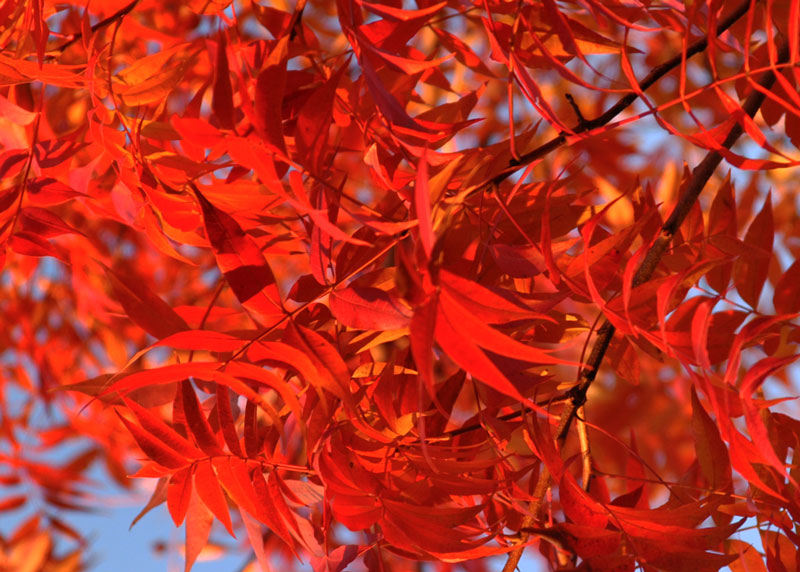
(For others to see, I’ve enclosed what we all seek in Chinese pistachios – the ultimate in red fall color.)
QUESTION 5
ARE PECAN LEAVES BAD FOR MY COMPOST PILE?
Question: Is there any reason I shouldn’t use pecan leaves in my compost? I’ve heard that the tannic acid will keep my other plants from growing well. Bob W., Austin.
Answer: Not at all. You’ll hear that same comment about oak leaves, and the fact is that some of our most fertile soils are found on the floors of hardwood forests. The secret is in shredding the leaves before you put them into the compost. Let them compost actively for 6 to 18 months. They’ll be a wonderful asset to your soil-building program.